
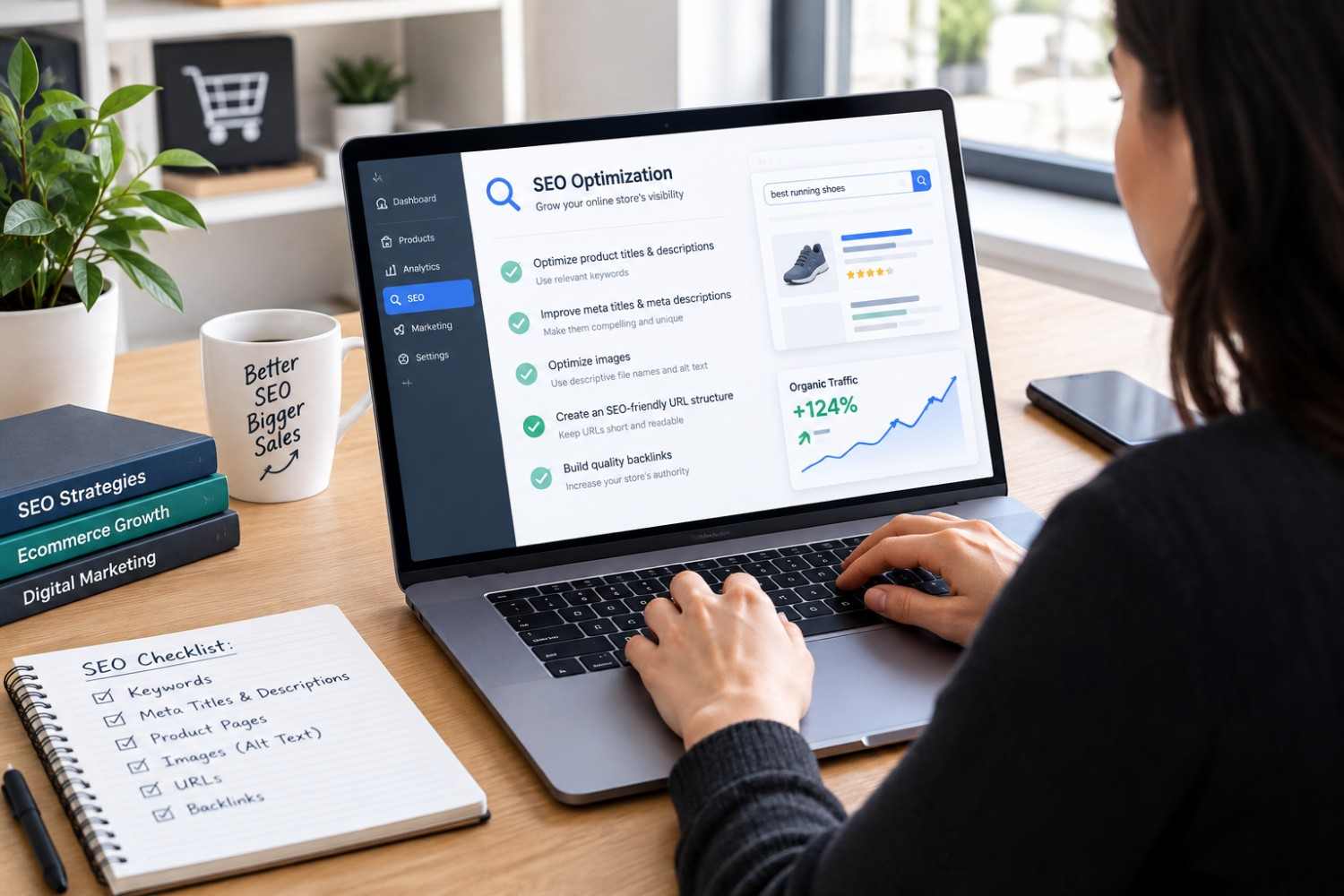
Running a successful online store requires more than just high-quality products and an attractive website design. With digital advertising costs rising and paid ad channels becoming increasingly volatile, search engine optimization (SEO) has emerged as an essential foundation for long-term e-commerce growth.
E-commerce SEO is the practice of optimizing your online store’s visibility in search engines like Google. Unlike paid search campaigns that stop delivering results the moment your budget runs out, a well-executed SEO strategy generates sustainable organic traffic month after month. By capturing high-intent shoppers directly at the moment they search for your products, robust organic optimization drives down overall Customer Acquisition Costs (CAC), maximizes customer lifetime value, and builds enduring equity in your brand’s digital footprint.
Keyword Research for E-Commerce
Keyword research forms the foundation of every high-performing e-commerce SEO strategy. Rather than guessing what your target audience is searching for, systematic keyword research allows you to map exact search behavior to specific product pages, collection categories, and educational resources.
Intent Mapping: Transactional vs. Informational
Understanding search intent is critical to maximizing conversions and avoiding misaligned traffic.
- Transactional Keywords: These queries indicate an immediate readiness to purchase. Users searching for terms like "buy leather cross-body bag," "best price wireless earbuds," or "discount ergonomic office chair" are near the bottom of the sales funnel. These keywords should be directly targeted on product pages and category/collection pages.
- Informational Keywords: These queries reflect top-of-funnel research. Phrases such as "how to clean leather bags," "difference between noise canceling and noise isolating," or "how to choose an ergonomic chair" represent users seeking answers. Target these keywords with comprehensive blog content, buyer guides, and comparison charts, then guide readers toward relevant product pages.
Competitor Analysis
Analyzing search competitors provides a blueprint of market demand. Identify established competitors ranking on page one for your target products, and examine:
- The exact keyword structures used in their URL handles and heading tags.
- How they group sub-categories to capture niche intent.
- Gaps in their catalog coverage that your store can fulfill.
Long-Tail Product Queries
While broad terms like "running shoes" carry massive search volume, they are fiercely competitive and often yield lower conversion rates. Focusing on highly specific, long-tail queries—such as "waterproof trail running shoes for wide feet"—yields lower competition, higher conversion rates, and lower bounce rates from highly targeted visitors.
On-Page SEO & Product Page Optimization
On-page SEO ensures search engine crawlers understand what your products are, while convincing human searchers to click through from search results.
Title Tags & Meta Descriptions
Your title tag is one of the strongest on-page ranking signals, while your meta description acts as your organic advertisement copy.
- Title Tag Best Practices: Keep titles under 60 characters to prevent truncation. Use a structured formula: [Primary Product Name] - [Key Feature/Category] | [Brand Name].
- Meta Description Best Practices: Keep descriptions between 145–160 characters. Highlight key selling points (e.g., Free Shipping, Handmade, 100% Organic) and include a direct call to action like "Shop now for exclusive deals."
Unique Product Descriptions
Avoid using manufacturer-supplied product descriptions. Duplicate descriptions across dozens of retail websites hurt performance in search engine indexation. Write unique, engaging copy for every SKU that focuses on user benefits, technical specifications, and primary keywords woven naturally throughout the text.
Structured Schema Markup
Implementing structured data using Schema.org formatting allows search engines to display rich snippets directly in Search Engine Results Pages (SERPs). Crucial e-commerce schema includes:
- Product: Defines the item as a physical product.
- Offer: Displays live price, currency, and stock availability (InStock / OutOfStock).
- Aggregate Rating & Review: Displays star ratings and customer review counts directly in search results to improve click-through rates.
Image Alt Text Optimization
Search engines rely on text to understand visual content. Optimize all product images by:
- Using descriptive file names (e.g., black-leather-crossbody-bag.jpg instead of IMG_0023.jpg).
- Writing clear, concise Alt Text that describes the product image accurately for accessibility and search indexing (e.g., alt="Women's black leather cross-body bag with gold zipper").
Site Architecture & URL Structure
A logical, easy-to-navigate site structure allows search engines to efficiently crawl and index your pages while enabling customers to find products with minimal friction.Home Page
├── Category Page (e.g., /footwear)
│ ├── Sub-Category Page (e.g., /footwear/running-shoes)
│ │ └── Product Page (e.g., /footwear/running-shoes/trail-pro-3)
Clean Hierarchy & Breadcrumbs
Keep your store hierarchy flat. As a rule of thumb, no product page should require more than three clicks to reach from the home page. Implement visible breadcrumb navigation at the top of category and product pages (e.g., Home > Men's > Shoes > Running). Breadcrumbs improve user navigation and provide structured internal linking paths for search bots.
Clean URLs and Variant Canonicalization
Ensure your URLs are simple, readable, and lower-case:
- Good: example.com/shoes/mens-running-shoes
- Bad: example.com/category.php?id=123&sort=desc
When products feature multiple color or size variants accessible via different URLs, use canonical tags (rel="canonical") pointing to the primary master product page. This prevents search engines from treating dynamic variant URLs as duplicate content.
Technical SEO Essentials
Technical performance directly impacts search engine rankings and user conversion rates.
Page Speed
- Problem Area: Unoptimized images, bulky app scripts, and heavy dynamic renders.
- Recommended Solution: Compress images to WebP formats, enable lazy loading, and audit third-party scripts.
Mobile Responsiveness
- Problem Area: Non-responsive viewports and tiny tap targets.
- Recommended Solution: Utilize fluid grid designs, test tap target sizes, and design for mobile-first indexing.
XML Sitemaps
- Problem Area: Unindexed new products and orphan URLs.
- Recommended Solution: Maintain dynamic XML sitemaps that automatically update on product launches.
Handling 404s
- Problem Area: Broken links resulting from discontinued products.
- Recommended Solution: Redirect (301) permanently removed items to the closest relevant category or product page.
Out-of-Stock Items
- Problem Area: Deleting out-of-stock pages, which causes crawl errors and index loss as those deleted products that lead to 404 hurting SEO ranking and lost customers as they just leave and search for that product somewhere.
- Recommended Solution: Keep pages live; display "Out of Stock" badges alongside back-in-stock notifications.
Are you currently using Importify to streamline your daily work flow? Discover how you can better make use of the Product Distribution to prevent the sale of out-of-stock items which often leads to inconvenience to the customer.
Handling SEO Redirects
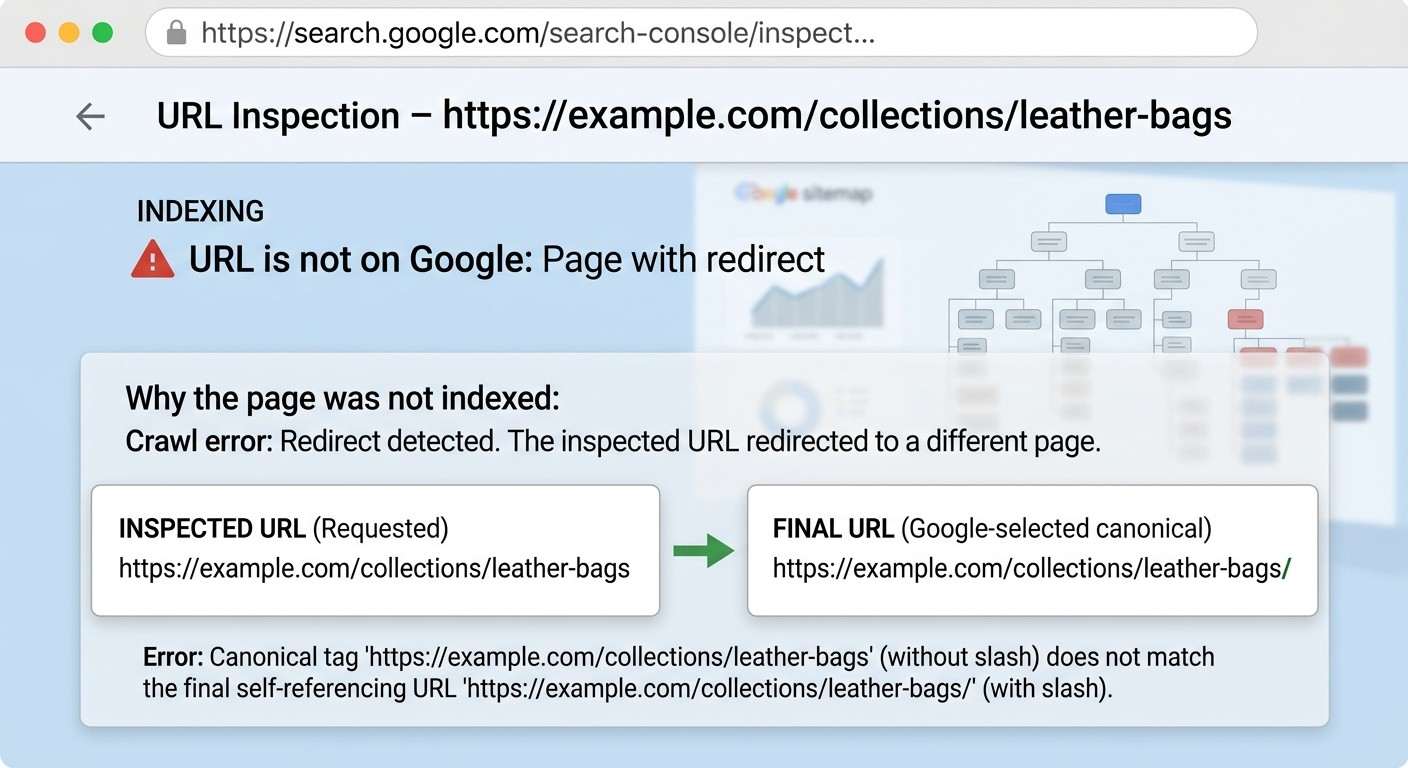
Google will not index a page if it serves as a redirect target or contains a conflicting redirect. Redirects occur for various technical reasons, but a common issue is URL trailing slash mismatches. For example, if your URL is https://example.com/page/ (with a trailing slash) but your canonical tag points to https://example.com/page (without a trailing slash), Google views these as two distinct URLs. To fix this, ensure your canonical tag exact-matches the final self-referencing URL structure of the live page.
Content Strategy & Internal Linking
A well-executed content strategy drives top-of-funnel traffic and builds niche domain authority.
Supporting Content Creation
Publish content that answers customer questions at every stage of the buying journey. Focus on:
- Comprehensive Buying Guides (e.g., "The Complete Guide to Choosing the Right Running Shoe").
- Product Comparisons (e.g., "Leather vs. Canvas Backpacks: Which is Right for You?").
- Care & Maintenance Tutorials (e.g., "How to Condition and Preserve Leather Goods").
Strategic Internal Linking
Connect informational blog posts directly to high-margin commercial pages using descriptive, keyword-rich anchor text. This passes equity from content pages to product pages and offers readers a path to convert.
Off-Page SEO & Backlink Building
Off-page optimization builds authority, signaling to search engines that your store is trusted within its niche.
- Digital PR: Create original research, market survey reports, or unique product innovations to secure features and links from industry publications.
- Supplier & Vendor Directories: Request links on the "Where to Buy" or stock lists of official suppliers whose products you distribute.
- Influencer & Reviewer Outreach: Send sample products to niche bloggers and reviewers in exchange for honest product reviews and editorial citations.
- Visual Asset Outreach: Build high-quality infographics, sizing charts, or instructional diagrams and allow other sites to embed them with source links back to your store.
Conclusion & Action Plan
Optimizing your online store for search engine visibility is an ongoing, high-return investment. By combining structured technical foundations with precise on-page targeting and continuous content creation, you build a channel that delivers scalable customer acquisition.